
Solid Fiber Pallet Slip Sheets & Shipping Pads
- Replace heavy wooden pallets to increase payload capacity by up to 15% per container.
- Durable slip sheets engineered specifically for forklift push-pull attachments.
- ISPM 15 exempt shipping slip sheets for hassle-free international export.
Marvatex Slip Sheets Can Help Reduce...
Acquisition Cost
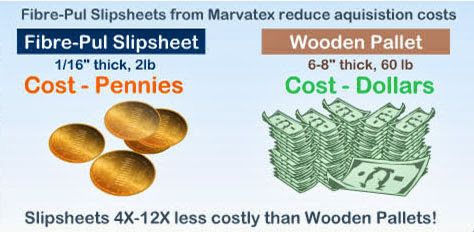
Fibre-Pul slip sheets from Marvatex Inc. reduce acquisition costs. Solid fiber slip sheets cost approximately $1.00 each depending on the size, thickness, and ordering quantity. A wooden pallet will cost between $6.00 and $12.00 each. Therefore, solid fiber slip sheets are six to twelve times less costly than wooden pallets.
READ MORE
Transportation Cost
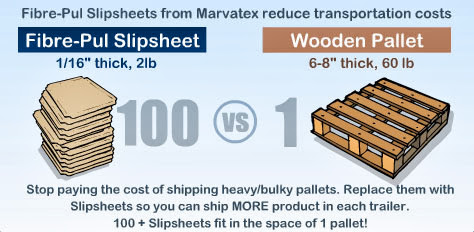
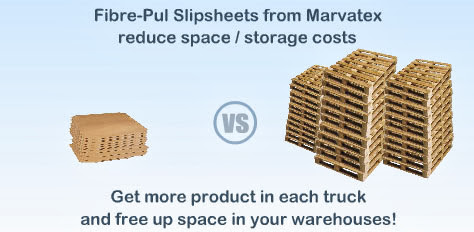
Fibre-Pul slip sheets from Marvatex reduce transportation costs. 100+ slip sheets fit in the space of 1 pallet. A slip sheet weighs approximately two pounds. A wooden pallet weighs approximately sixty pounds!
READ MORE
Labor Cost
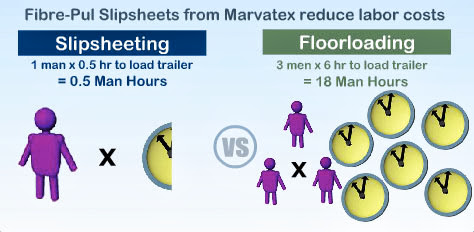
If you load your trailers by hand (floor loading) the use of slip sheets will drastically reduce your labor costs by automating the loading function. It will take 3 men 6 hours to floor load a trailer. This is a total of 18 man hours. In comparison, it will take 1 man ½ hour to load a trailer using slip sheets. This is a savings of 17 ½ man hours per trailer.
READ MORE
Storage Cost
Fibre-Pul slip sheets from Marvatex will free up warehouse space. 150 slip sheets will fit in the same space as one wooden pallet.
READ MORE
Administrative Cost
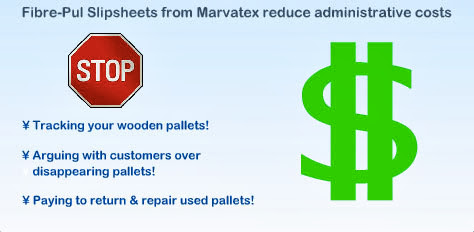
Fibre-Pul slip sheets from Marvatex will reduce administrative costs. A slip sheet is disposable and serves the purpose of transporting one unitized load to its destination. This eliminates the headache of tracking your wooden pallets, arguing with customers over disappearing pallets, and paying to return and repair used pallets.
READ MORE
Worker Injuries
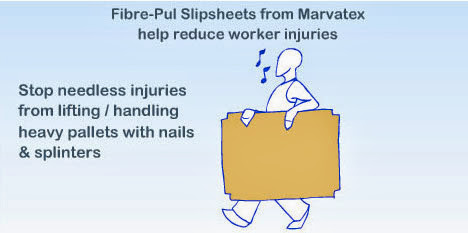
Fibre-Pul slip sheets from Marvatex help reduce worker injuries. Slip sheets ensure a safer work environment by avoiding needless injuries due to lifting heavy wooden pallets. Wooden pallets often have protruding nails and splinters that cause injuries.
READ MORE
Insect & Rodent Problems
Fibre-Pul slip sheets from Marvatex help eliminate rodent and insect infestation. Wooden pallets offer a home to insects and rodents. Slip sheets afford no such food or shelter to pests and critters.
READ MORE
Product Waste
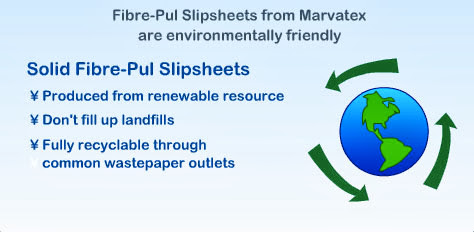
Fibre-Pul slip sheets from Marvatex are environmentally friendly. Slip sheets are manufactured from paperboard, a renewable resource. Slip sheets are fully recyclable through common wastepaper outlets and have a monetary wastepaper value. Slip sheets do not fill up landfills and meet export pallet platform restrictions.
READ MORE
What are solid fiber slip sheets?
Q: Are solid fiber slip sheets the same as cardboard slip sheets? A: While cardboard slip sheets (corrugated) use a fluted core, heavy-duty solid fiber slip sheets use multi-ply kraft paperboard to prevent tearing under tension during forklift material handling.
Q: Do I need special equipment to use slip sheets? A: Yes, every facility handling your shipment needs forklifts equipped with push-pull attachments to properly maneuver the load.
Q: Why use slip sheets instead of pallets? A: Using slip sheets for pallets serves as a lightweight alternative to wood pallets. Fiber slip sheets cost 6x to 12x less than wooden pallets and free up warehouse storage space.

High-Performance Solid Fiber Slip Sheets for Industrial Shipping
Integrating solid fiber slip sheets for pallets into your supply chain is a proven strategy to streamline material handling, lower transit costs, and maximize warehouse capacity. As a primary slip sheet manufacturer and wholesale supplier, Marvatex produces durable kraft slip sheets and recycled slip sheets engineered to withstand high-volume commercial shipping.
Choosing paperboard slip sheets instead of pallets serves as a lightweight, cost-effective pallet alternative for both domestic transport and international container export. Built specifically for forklift push-pull attachments, our heavy-duty fiber slip sheets maintain vertical load stability without tearing or slipping under tension. Whether you need standard dimensions or custom-cut shipping slip sheets, partnering direct with a manufacturer ensures factory-direct pricing, consistent quality, and scalable bulk pallet slip sheet supply for your operations. Contact our packaging engineers today for custom specifications or to request a volume quote.
Solid Fiber Slip Sheets FAQ
What are slip sheets?
The word slip sheet is a generic term that usually refers to thin pallet-sized sheets made of virgin kraft linerboard, plastic, chipboard, or corrugated fiberboard used in commercial shipping. Often, they replace the use of wooden pallets. Slip sheets are also referred to as solid fiber slip sheets and solid fibre slip sheet, with and without hyphens.
Why are there so many different types of slip sheets? How do I know which is right for me?
There are many different types of slip sheets because there are various applications for slip sheets. It all depends on the application. If you are using the sheet to divide layers of product or to protect the product from the pallet then you can use a corrugated or chipboard sheet. We call this a pallet pad or divider sheet. The most common type of slip sheet is used to replace wooden pallets. This type of slip sheet we refer to as a Fibre-Pul slipsheet or a Push-Pull slip sheet. These sheets are used with a Push/Pull attachment that goes onto your fork lift truck. This sheet must be strong enough to pull the full weight of your unitized load. Therefore, this sheet is made of all virgin kraft linerboard.
What are Fibre-Pul solid fibre slip sheets?
Fibre-Pul solid fibre slip sheets is Fibre Converter’s brand name for the all virgin kraft linerboard slip sheet. These sheets usually have a 3” or 4” lip that extends from the unitized load. These sheets are used with a Push/Pull attachment.
Are there standard sizes for Fibre-Pul slip sheets?
We manufacture all our products to our customer’s specifications. However, the most common sizes are a 43” x 51” and a 44” x 52”. This is because the common load area for a standard pallet is 40” x 48”. Fibre-Pul slip sheets usually have a 3” or 4” lip for the push pull attachment to grasp onto. So the overall size is a 43” x 51” or a 44” x 52”.
Do you stock any Fibre-Pul slip sheets?
We do not stock Fibre-Pul slip sheets. There are too many different sizes and calipers to only stock one size. However, we do stock 37” x 45” anti- slip paper and 40” x 48” .019 chipboard pallet pads.
Are Fibre-Pul solid fiber slip sheets palletizer friendly?
Yes, our slip sheets are dispenser friendly. They are produced to smoothly feed through automatic equipment.
Where can I get a Push/Pull Attachment?
You should check with your fork lift truck provider. They should be able to help you. If you do not have a fork lift truck provider then you can contact the manufacturer of these attachments, Cascade Corp. Cascade Corp.’s website is www.cascorp.com. Their website will give you information on their push/pull attachments and also list their dealers.
Is there a learning curve involved in using Fibre-Pul slip sheets?
Yes, if your forklift truck drivers are new to slip sheets then we recommend starting with a thicker sheet with a larger lip. After a couple of months, when your driver is accustomed to working with slip sheets, it should be possible to scale down in caliper and lip size.
How do I know which size and caliper sheet I need?
Our technicians will be happy to work with you to determine a caliper and size for you. We will need to know how much weight you are pulling to recommend the caliper. We will also need to know the size of your load area and if you will need to pull from one, two, three, or all four sides of the slip sheet. We can then determine the size of the sheet.
Are your sheets environmentally friendly?
Yes, our sheets are environmentally friendly. Our sheets are 100% recyclable and 100% biodegradable. They weigh much less than a wooden pallet so you are able to ship more products in a truck with a slip sheet. This reduces fuel costs and the amount of fuel consumed.